October 23, 2006

End of Ramadan


Ramadan is coming to a close with the holiday Aid Al Fitr tommorrow and Wednesday capping off the month long festives. It has been difficult, if not chaotic at times. Hunger and thirst, shops closed, expectations of respecting faith sometimes tangling with assumptions of the faithless. But overall, a great experience that I wouldn't trade. I didn't fast all the time; not when traveling, hiking, or for several days after the first week when I became ill. But I found when I did, it made the evening meal, lftar more enjoyable. It makes you more thankful and it can teach you that the sweet isn't as sweet without the sour.

October 6, 2006

Happy Birthday Mom!


Hope its a good one. Right to left. “Eid Milad Said” or Holiday-Birth-Happy.

The E in Eid is actually ع and it doesn’t exist in English. It requires pronouncing the ‘a’ in “fat” with the tongue against the bottom of the mouth and from as deep in the throat as possible. Arabic vocabulary is not nearly as difficult as the pronunciation. Say something like “holiday” as “hooliday” in arabic and people might look at you blankly. There are 8 constants like this that don’t exist in English.

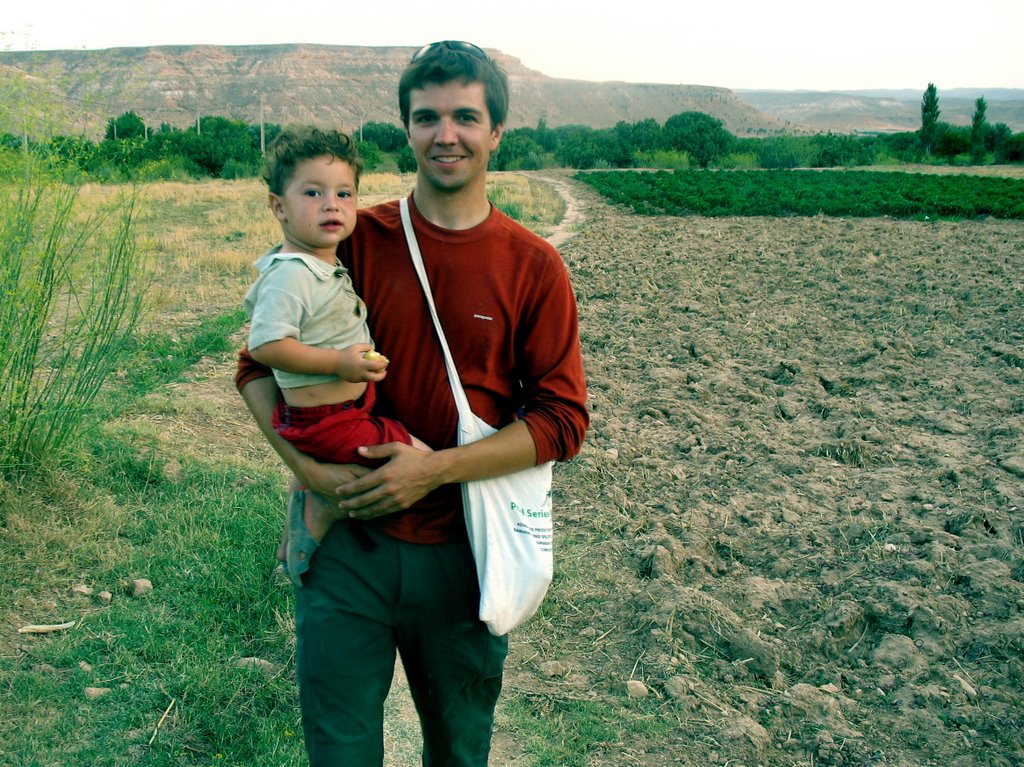
It’s funny that before and after this photo, my host brothers and sister were all smiles, laughing, doing handstands against the walls.

October 4, 2006

Ramadan Part I: thirsty with a headache

Ramadan began last Sunday on the 24th in accordance with the new lunar cycle and will last 30 days. In Saudi Arabia, it began the day before. I’ve been staying with my host family in the evenings to accommodate the schedule, but have also broke fast with 3 other families. Here’s a daily schedule during Ramadan.

6 PM Following call to prayer, fast is broken with prayer and meal iftar
630-8 Primetime TV (4 comedies including bloopers on 2M.)
8-9 Men go to mosque for prayer
9-12 Snack, play cards, TV, etc
12 AM 2nd meal
1230-4 Sleep, talk, play cards, etc
4 AM Breakfast
4 AM-6 PM Sleep, work, etc

Ramadan’s most important feature is the complete abstinence from food and drink from daybreak to sunset. All muslims fast, but travelers, menstruating women, the sick, and the pre-pubescent are exempt. Non-muslims are not expected to fast, but I’ve found its appreciated and an important integration tool at my site. I did not fast the first day; we were traveling and I woke up late.

A good introduction to Ramadan can be found in Riverbend's "Baghdad Burning."

“The most active part of the whole day is the quarter of an hour directly before breaking the fast... the whole family is often in a flurry of action, with someone setting the table, someone carrying the food, someone giving orders about where to put everything... and everyone impatient with hunger. The last five minutes before you hear the call for prayer signifying the end of the fast are always the most difficult. Every second of those last five minutes passes with the heaviness of an hour... you can literally see every one strain to hear the sound of the call for prayer echoing through the Baghdad streets. And then it is finally time for futtoor... and we begin to eat with relish. The platter of rice that seemed ridiculously small 15 minutes ago, is now ‘too much’ and no one eats as much as they had hoped they were going to eat- everyone is exhausted with simply contemplating the food, the choices and the possibilities. After futtoor, the smokers fall upon their cigarettes with an enthusiasm only other smokers can appreciate. We watch them taking puff after puff with a contentment that even screaming kids, and loud televisions cannot taint.”

The previous is true, although smoking is less public and prevalent in my small site. The wrath from some women here might be worse than any physical withdrawal.

I had some anxiety before fasting began. No food intake was not a problem, but I found no drinking unpalatable. Its hard to shake thirst. A few Moroccans like my host brothers sleep through most of the day, but most maintain their daily activities. I feel sorry for those in tourism or the restaurant industry.

Overall, Ramadan is a joyous event. Fasting during the day is to reinforce one’s commitment to faith and to develop appreciation for ones good fortune. Breaking fast and the time spent together in the evenings is a celebration of the gathered family.

“When food is shared and laughter is abundant, family exists.”

Ramble bamble jamble

-Thanks to my grandmas again for their letters a week. Graham just shakes his head with jealousy every time we go into the post office. Grandma Ocie, I received your Turkish cookbook and find it more than adaptable. Thanks. All the ingredients are available to me and there’s no instructions like “preheat your oven.” I don’t know how you preheat a bbq grill with 4 enclosed aluminum walls.

-I also received a package from Mom and Dad. Racquetballs, t-shirt, contacts, cards, etc. Thanks. Playing racquetball with beach paddles inside the house is one way to pass the time. And who knew that Uno would be so popular? It’s a challenger to Rummy at the taxi stand now.

-To a few friends that keep sending me football and baseball teasers, thanks for remembering me. Hope you enjoy those election commercials that break up the games.

-I love the story of Ray LaMontagne, a musician whose debut CD “Trouble” is new to me, although it came out two years ago. He was a quiet man working nights at a shoe factory and he woke up one day to an Allman Brothers tune on the radio. He told himself “I need to learn how to play guitar because this makes me happy.” A year later, he put out a fine CD. Last month he released his sophomore album.

In the footsteps of National Geographic


Josh and I visited the ancient Chouara tanneries in Fes last Sunday, one of three main tanneries in the old medina or Fes el-Bali. This tannery is the largest of the three, is over 600 years old, and is nearly impossible to find without the help of a guide. After my visit, I came across a recent National Geographic video podcast on ITunes entitled “Toughest Jobs: Tannery Kid.” Its a short clip following the daily life of a young apprentice in I believe the same tannery I visited. I highly recommend watching it.

The Chouara tanneries, like the Guerniz tanneries we also visited, is tucked into a landscape of buildings. A narrow entry leads into an open air area where men wash, clean, and kneed lambskin in a honeycomb of vats. One guidebooks description: “scantily dressed tanners appear like so many human storks...their legs working through the pools, bobbing down to worry a skin and then striding off to wash at the fresh-water standpipes.” The NG documentary describes this as one the “foulest smelling places on earth” because of the skin excrement and pigeon droppings (collected from rooftops and used to soften the leather) in standing water. However, walking around the tannery, I didn’t find the smell that strong; probably because it was not enclosed and the temperature was temperate. A windowless meat packing plant seems worse.

It is a difficult job though. Long hours, physical work, and little pay. While two finished lambskins or a pair of native Babouche slippers sell for around 100 dhms ($12), daily wages start at 20 dhms for an apprentice up to 50 dhms for an experienced tanner. By comparison, construction workers make 50-80 dhms daily and teachers have a monthly salary of around 2500 dhms. Rent in my region is between 400-800, 800-2500 in the cities. The poorest families in my region make 5000 dhms ($600) or less annually. And many of those might never visit Fes, Morocco’s cultural mecca five hours away.

Additionally, the federal retirement fund is not available to those outside of government employment, nor do they pay into it. In a recent survey I read, over 95% of Moroccans expect their children or other loved ones to care for them financially and physically when they are no longer able to.


(The Guerniz tanneries above)

Fes: McDonalds and beyond


I traveled to the small, former Jewish town of Sefrou near Fes last weekend with Josh to see a friend. Before and during WWII, Morocco had a vibrant Jewish population of around 300,000, many of which lived and operated commerce in Fes. During WWII, Morocco protected its Jewish population from the genocidal policies of Europe even while it was under French control. Following the establishment of the state of Israel after the war, many Moroccan Jews emigrated to the Middle East.

Sefrou was interesting, but Fes was more exciting. Five synagogues remain in the jewish quarter, the oldest built in the 17th century. Its a testament to Moroccans tolerance that they encourage Islam, but don’t prostatalize their faith. Those I do meet that push religion are often strangers who I feel are trying to get in my back pocket. Their actions seem contradictory.

Passing through Fes on our way home, we stopped for lunch at McDonald’s around noon Sunday. The first day of Ramadan, we walked in and were alone when we received our food. It was strange sight when we saw approximately twenty white faces walking towards us in the restaurant. We found out later that these were Americans and Europeans that lived in the city and had just attended a bilingual Christian service. I’ve heard that their is a gated Christian missonary in Fes, but I haven’t confirmed this. It would also be illegal; passing out bibles is an easy way to receive the go to jail card or be deported. Anyways, I talked with several Americans there, but Josh and I found that we couldn’t stop staring at them. Their response was to ignore us.

Happy New Years Yesterday


What doesn’t change and remain, remains and grows strange. -Walt Whitman

The fall season is barreling in with several storms over the last weeks. Autumn weather is made for both expression and melancholy. For me, Autumn and the now passed September are also like the beginning of new year. Maybe this is conditioning from years of schooling. Like a new term, it comes with mixed feelings. Not wanting to leave the past behind, but anxious for the future. Having been in Morocco now eight months, I feel I’m settled and comfortable, but I look forward or dread several challenges in the coming months and year. One of those could be winter; Moroccans make a big deal of the season. They say once you become cold, its hard to warm up. Right now, I’ll embrace the chill in the air as the start of something new.

September 22, 2006

Q and A

I’ve been busy with work and travel lately. I want to finish things before Ramadan begins this Sunday, a period when I perceive everything will slow to a crawl. I’ll try to post something longer next week, but will open it up for a Q and A. I reason that many things that might be foreign to others are now normal for me. I also have an inquisitive extended family (ie Anna & Co.). Just post a question in the comments section and I’ll try to answer it a timely basis. This can be a continuing conversation; no need for a deadline.

Congratulations is due to my mother. Earlier this year she was selected as the Master Teacher from USD 417 and she’s recently been selected as 1 of 8 finalists for Kansas Teacher of the Year, to be announced in November. Mom, I’m happy for you. It’s a well deserved honor.

I’ve also updated “my photos.”

September 8, 2006

After another storm


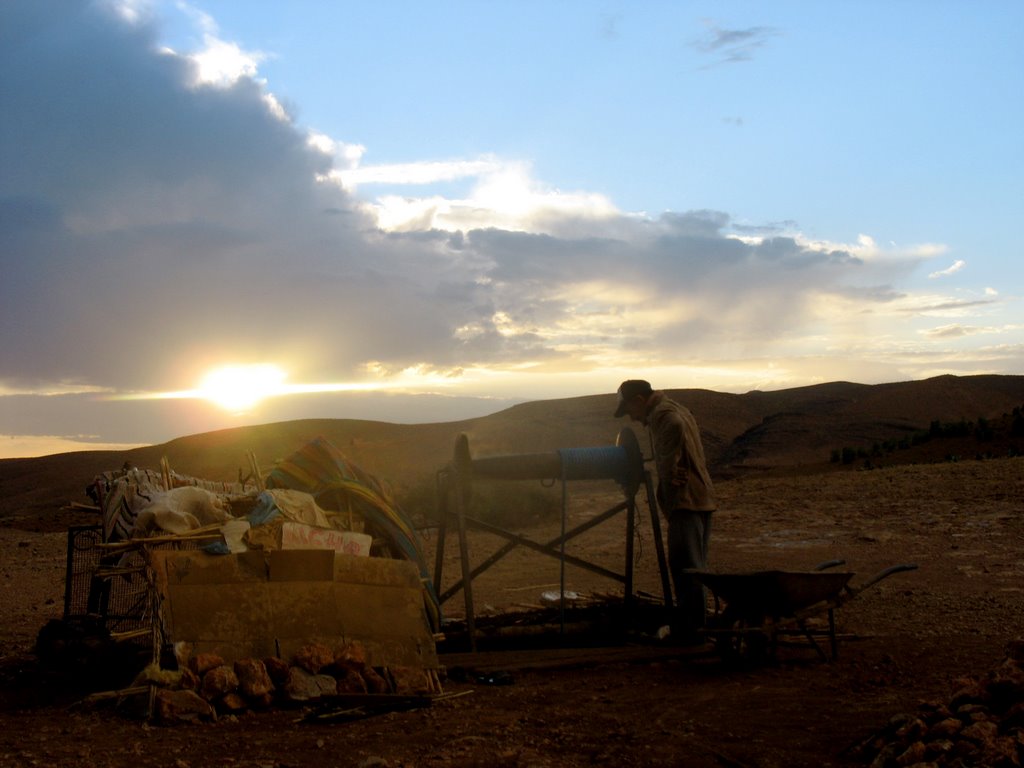
After I a storm last week, I walked upon these two men digging a well a short distance from my house. There was a man probably 15 feet down; he had not reached water yet.

Police silhouette


A police office at a government building in Oujda. Photos of law enforcement and the military are discouraged; I’ve heard they’ll take your film. I find it more interesting that we’re not allowed to take a photo of the U.S. Embassy in Rabat, although you can go up to the gate and talk with the marines on duty.

In our region, we’re not governed by the police, but by the gendarms (ie county cops). We report when leaving or returning to the area to the chief officer. During the recent Israeli-Lebanon crisis, he called everyday to find our location and called ahead if we were traveling somewhere. Tensions have since subsided following the ceasefire. His main concern that he vocalizes to us now is European Moroccans, those natives that work in Spain, France, and the Netherlands for 10 months and then return home. Many send money back to their families, thus providing a much needed income, particularly in the north. Some also return for two months of carousing, which is something the country has not assimilated yet.

September 6, 2006

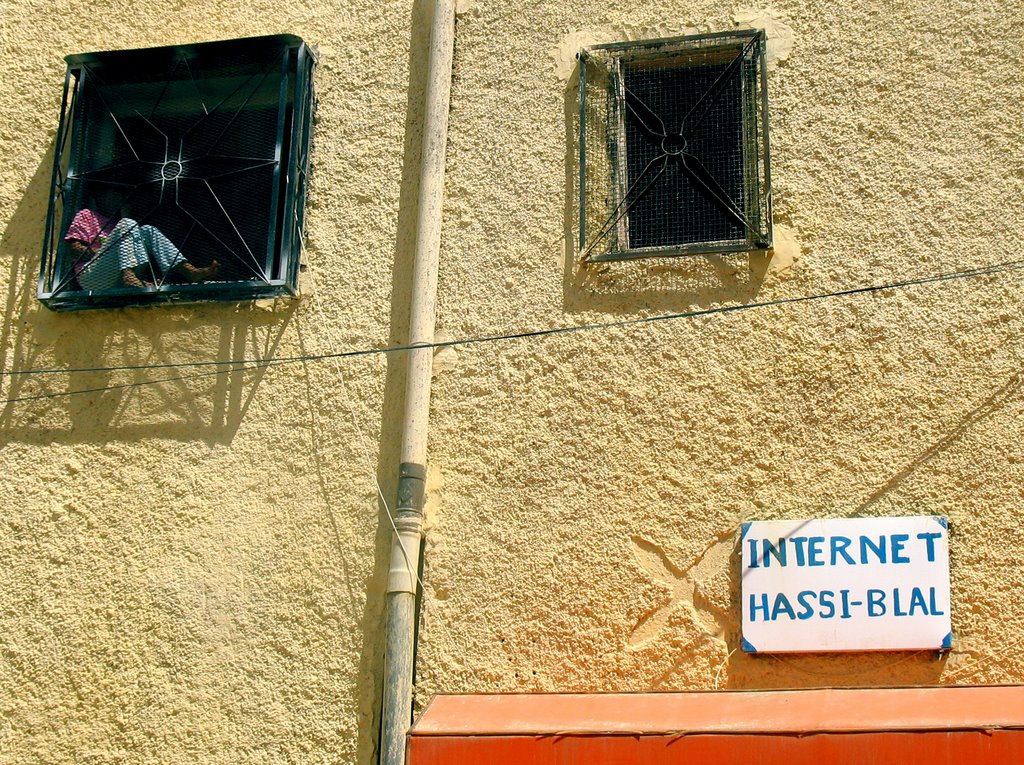
Outside my cyber cafe

The down and out


“I remember the first time I saw someone lying on the cold street,
I thought, I can’t walk past here, this can’t just be true.
But I learned by example to just keep moving my feet,
it’s amazing the things that we all learn to do.”
-from Ani DiFranco’s song “Subdivision.”

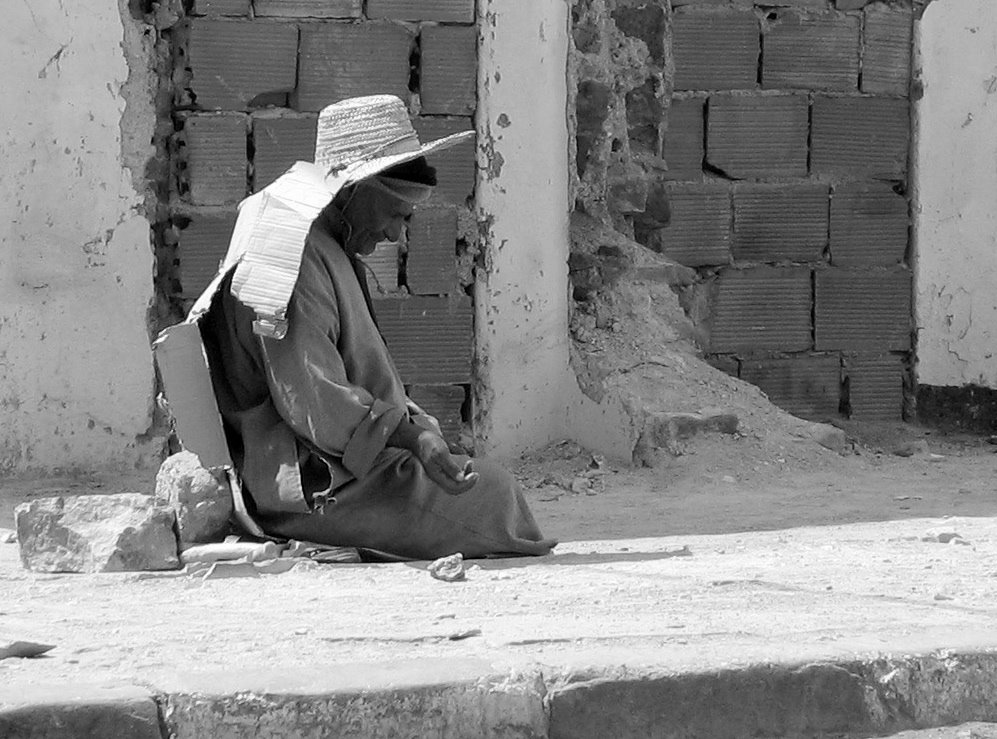
Beggars are common here, particularly in larger cities. Homelessness exists too, although it seems less public than in the states. No one pushes shopping carts or sleeps in the public parks. There are small Hoovervilles, but they exist on the periphery and in cracks of the ‘imperial cities’. I also believe less of the population per capita is homeless than in the U.S., perhaps because households are larger and housing is cheaper. However, these unfortunate souls don’t receive any government assistance. There is no help, where there might be a soup kitchen and a shelter stateside.

As an example, as Graham and I were returning late one weekend night to a hotel in Fes two months ago, we saw in front of us in the corner a mother sleeping with her three children, none older than ten. Her youngest, probably less than a year, was sandwiched between her and the others.

Hmm.. in this situation, what do you do? No stores were open to buy them any food. Do you wake her up and give her money? In John Steinbeck’s depression era novel “The Grapes of Wrath,” one hapless character, in response to a lack of government or outside aid, tells his son “the poor take care of themselves.” This is unacceptable and is the injustice that Steinbeck was trying to give voice to.

Later, Steinbeck says “the poor will always be with us.” True, but how does one ease their burden? Like that night when I walked past that young family on the street, we have the answers, but lack the will (..or something) to act.

Fantasia


The eight day wedding that I wrote about in one of my last posts concluded last week with Fantasia, pictured above. In this event, horsemen line up at one end of an open field, wait for a period, then they get the horses to rise up on their back legs in unison. Next, they charge down the field and fire their rifles together. This is often done in several waves which follow each other. To his chagrin, if a rider misfires noticeably late or early, they tease him by making him dismount and walk his horse back. In all, this is repeated for several hours.

August 29, 2006

A panoramic view


My site photoshopped. My house is a short distance past the white mosque on the right via the paved road. Areas of my site have different names; I’ll call them neighborhoods. Starting on the left of the photo to the mosque is the area called Taznight, where my host family lives. After the mosque, one enters Mdafa or “high zoea” where I live and which continues until a paved road splits and heads towards the river and continues south into the Sahara. From Mdafa to the southern edge of town is Harash or “low zoea.” More confusing is my attempts to figure out area boundaries across the river, where Labkhata, Rwabah, and Ouled Khlifa are located. The river is called Oued El Hay (the living river) and extends more than 100 km.

August 26, 2006

Brother and neighbors

My host brother Yosshine.


Hassan (11) and Oumayma (7), the children of my neighbor Meddi, who is a professor in Oujda and is returning next week to begin the school year. Like elsewhere, children here are ornery. And they love to make fun of me; laughing at my strange behavior, attempting to teach me dirty words, and imitating my arabic.

I think there’s a difference between these city kids, Hassan and Oumayma, and those in my village. Besides a father whose a professor and living in a city of half a million, they attend a private school, where teachers don’t use the rote memorization used in public schools, but encourage critical thinking and problem solving. The result is that in general, these children have more self confidence.

I’ve read that educational reform in the Arab world is being led by the United Arab Emirates. Arab scholar Muhammad Boneb from Qatar call this a change from monologue to dialogue learning. “Our Arab culture has been raised on monologue. Hey listen, but don’t talk. Today, we have to give children the opportunity to talk.”

Blair speech in L.A.

UK Prime Minister Tony Blair made the following remarks several weeks ago in the midst of the Lebanon/Israel crisis.

“..We must commit ourselves to a complete renaissance of our strategy to defeat those that threaten us. There is an arc of extremism now stretching across the Middle East and touching, with increasing definition, countries far outside that region. To defeat it will need an alliance of moderation, that paints a different future in which Muslim, Jew and Christian; Arab and Western; wealthy and developing nations can make progress in peace and harmony with each other. My argument to you today is this: we will not win the battle against this global extremism unless we win it at the level of values as much as force, unless we show we are even-handed, fair and just in our application of those values to the world...

Unless we re-appraise our strategy, unless we revitalise the broader global agenda on poverty, climate change, trade, and in respect of the Middle East, bend every sinew of our will to making peace between Israel and Palestine, we will not win. And this is a battle we must win.”

Find the rest at http://www.number10.gov.uk/output/Page9948.asp. I think this is a good speech, maybe a Winston Churchill “Iron Curtain” speech of our time. All we need know is a Truman to deliver.

I’m reading an old biography on Leo Tolstoy by author Isaiah Berlin titled “The Hedgehog and the Fox.” He writes “there is a line among the fragments of the Greek poet Archilochus which says: ‘the fox knows many things, but the hedgehog knows one big thing.’” Berlin divides leaders, thinkers, and others into two categories; the hedgehog, who tries to integrate all of his experiences and thoughts into a single, overarching concept of life and the fox, who as he puts it, have ideas about the world "without seeking to fit them into, or exclude them from, any one unchanging, all-embracing, sometimes self-contradictory and incomplete, at times fanatical, unitary inner vision."

Berlin summarizes that the famous Russian author was a fox that wanted to be a hedgehog in his latter years. I think Tony Blair is a fox too. He’s showed himself to be steadfast and ethical, not insular or sanctimonious. Now, if Blair is the fox of modern times, who is the hedgehog?

Back at site

Work at my site is picking up. Next month, en shalla, I’ll start teaching English at the women’s center in the evening. I’m looking forward to this and getting my lesson plans ready. Alphabet, numbers, then reflexive and transitive verbs. Also, I’ve been interviewing people, specifically farmers about their land management practices; what is public/private, how is water allocated, what’s the crop calendar, are chemicals used (no), etc. This is done in effort to establish the communities needs and strengths. Learning the language and culture makes this an incremental process.

The project that is my white whale, by which I mean I’ll be chasing it down for probably the next two years in hope’s of completing it before I leave is wastewater management. The main association that I’ll be working with this on has a large grant from the Ministry of the Environment and they want me to help them find a way to take their wastewater, clean it biologically (not chemically), and release it into the river. Peace Corps Morocco has done projects like this elsewhere, so the information and examples are available and I have an idea what the end product is, its just getting there. Like the language and cultural, this is incremental process.

My research in my natural reserve, SIBE Lalla Shafia, and on my ecological resource book is on standby. I need transportation (4x4- kat kat) into the SIBE from the forest department and flora/fauna books from them and PC to properly identify species in my site. I have photos with the names of most species thanks to the help of my uncle, the herb doctor, but need to double check. Often I feel like what I could accomplish in a day back home takes a week here.

Since I got back on Monday, there’s been no water at my outside tap or at one of the communal one’s 200 yards away. Therefore, I’ve had to schlep my water jugs 2 km to the closest spring at my site. It’s not a great inconvenience, it just means I use less water and bathe in the river. For some of my neighbors at a higher elevation that don’t have running water because of a lack of water pressure, this is the norm. Children or donkeys carry water jugs to communal taps, the springs, or the river. I’d be more concerned about this water issue if I wasn’t surrounded by it.

August is almost over, but the wedding celebrations that epitomize the month are still widespread. Last week, I went to a wedding that started at 10 PM. Dinner was at 11 PM and I left by midnight, but the wedding continued until 6 AM. Last night, I attended the first evening of an 8 day wedding. The father of the groom is the zoeat of my community, which means that he is the tribal leader of the area and a descendant of the prophet Mohammed. His position was once political, economic, and social, but now only remains the previous. My relationship with him should be unique, he’s unofficially the most important man in the community. A full explanation deserves its own post later. Of note, he has invited the whole commune (6 towns) to the weddings- about 5,000 people. Last night, I sat amongst 500 plus men in 5 tents listening to music and watching them dance. The women were inside a nearby house. I don’t know there number. Gender separation is interesting. For example, at the swimming pool on Sundays, 200 men will be wading in a 25 meter pool, while the women will be in an enclosed room where there is a 5 meter pool.

So, Moroccan weddings are marathon events. Lots of dancing, music is played very loud, and participants often sit in the berber squat for hours. In the cities, they drive around, blaring their horns with passengers hanging out the windows. And this joyriding can continue all night, making sleep difficult.

“Many things end with acceptance not understanding.”

A quixotic journey


This last weekend Josh, Graham, my friend Matt from Khenifra and myself went to Cap des Trois Fourches, located on the tip of a peninsula 30 kilometers past the Spanish province of Mellila. It was one of my best experiences in Morocco so far. It was a quixotic journey.

We headed north last Saturday. The road to the coastal city of Nador was uneventful, which is perhaps an indicator of sorts of our cultural assimilation. In the city streets or on the highway here, taxi drivers speed with reckless abandon, making wild passes and dangerous turns that would normally make one crawl up their seat, but is now yawned upon. They are professionals. In fact, we often complain about the opposite, when our carrier drives two slow or when he fails to make a pass.

From Nador, we traveled 30 km on a windy road that hugs the coast and cuts through numerous small fishing towns, where small blue row boats carry men past the coves out into sea. Upon reaching our destination, a military lighthouse that resembled a monastery, we handed over our passports, identified ourselves and chatted up a half dozen soldiers. The lighthouse exists there to thwart contraband from coming and leaving Morocco.

We found our camping spot in a cove near the lighthouse. Anxious to swim, we jumped in the clear, cool green water with schools of fish swimming amongst the numerous reefs. Without goggles and swimming like a bear (they perform the backstroke in water, right), I didn’t see the jellyfish or kindilou lbahr (candle of the sea). I was stung once on the shoulder and still have the scar (hope its permanent). After that, we got out of the water, saw that the tide had brought in many jellies, and decided to snorkel elsewhere.

After lunch, we hiked to the other side of the lighthouse, where locals were swimming at a small beach. Of greater interest, we saw several boys jumping off a cliff probably 35 feet high. As is typical with males in a group, once together you start thinking with one brain. We all climbed up the cliff and jumped off. It wasn’t until right after I made the leap that I began to think, “maybe this wasn’t such a good idea.” Too late for that; we yelled “Yallah” (Oh my god!) and enjoyed the free fall. Like the whole trip, this deserves seconds.
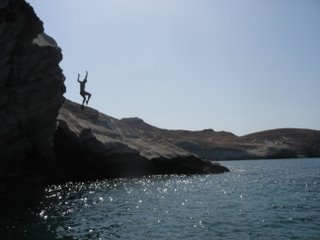
We swam and laid around the rest of the afternoon, taking turns snorkeling with our new purchase, a spear-gun. It’s amazing that just when I think I’m gaining a grasp on the world, that its strangeness and size are diminishing, an underwater ecosystem reveals itself. I say that with some naivety because I’m from centerville, but also with an appreciation for a place where humanity’s thick, crude hands have left less of a mark.

“Nature’s beauty still outshines the treasures of human invention.”

With respect for nature, we still hunted like Captain Ahab. The fish were too small and quick, with suitable fish being too deep- we need fins and a weight belt to dive down quickly for them. Graham and Josh, however, did manage to catch a couple. After I fired one time, the spear slipped off the string and I had to dive 20 feet to retrieve it where I also found a conch, but we tossed this back after the first night because of its foul smell. Catching little the first day, we were left with food rations of rice, bananas, some bread, and hot sauce. I’d like to say we could have starved, but we had a lot of rice. However, the octupi caught the following day did diversify our spread and sweetened the trip.

On the way back, we stopped at a friends house in Berkane. After showering and while the others were doing the same, I went down to the corner store to get some powder milk, hot sauce, and soy sauce; the necessities. . As I walking back, I met a man on the street that spoke some English. He said: “Hey my friend, how are you?” Good. “Why don’t you go back to Europe.” I was taken back a little because I was unprepared andthis is uncommon. After I passed him I thought I should have rebutted, “but I’m not European, I’m from America.” Now is probably not the best time for that though.

The worlds a mixed bag, not as simple as good versus evil, but its often the paradox of humanity that just when ugliness occurs, something nice, sometimes beautiful happens to lift you up and restore your faith.

Later, as we were saying goodbye to Matt at the train station in Oujda, we started ‘spinning the yarn’ (I hear some people are nostalgic for that phrase) with a porter that Graham and I have befriended. He’s a friendly, elderly gentleman that has worked at the station for over 20 years. As the train pulled in and our conversation curbed, he turned to us and said “I like Americans. You are nice and all of you speak arabic.” We believe he’s only spoke with the 5 PCV’s that have been through Oujda.

“To avoid cynicism, one must learn to recognize human error and accept it as a constant variable.”

August 18, 2006

Taza girls

Two neighbors of a PCV near Taza.

"I’ve often thought there ought to be a manual to hand to kids, telling them what kind of planet they’re on. Why they don’t fall off it, how much time they’ve probably got here, how to avoid poison ivy, and so on. I tried to write one once. It was called ‘Welcome to Earth’. But I got stuck on explaining why we don’t fall off the planet. Gravity is just a word. It doesn’t explain anything. If I could get past gravity, I’d tell them how we reproduce, how long we’ve been here, apparently, and a little bit about evolution. And one thing I would really like to tell them about is cultural relativity. I didn’t learn until I was in college about other cultures, and I should have learned that in first grade. A first grader should understand that his or her culture isn t a rational invention and that there are thousands of other cultures and they all work pretty well; that all cultures function on faith rather than truth; that there are lots of alternatives to our own society. Cultural relativity is defensible and attractive. It’s also a source of hope. It means we don’t have to continue this way if we don’t like it." -Kurt Vonnegut

A fisherman's life


Photo from near Essaouira taken by Lindsey Ludwig.

“I am within and without, simultaneously enchanted and repelled by the inexhaustible variety of life.” -F. Scott Fitzgerald